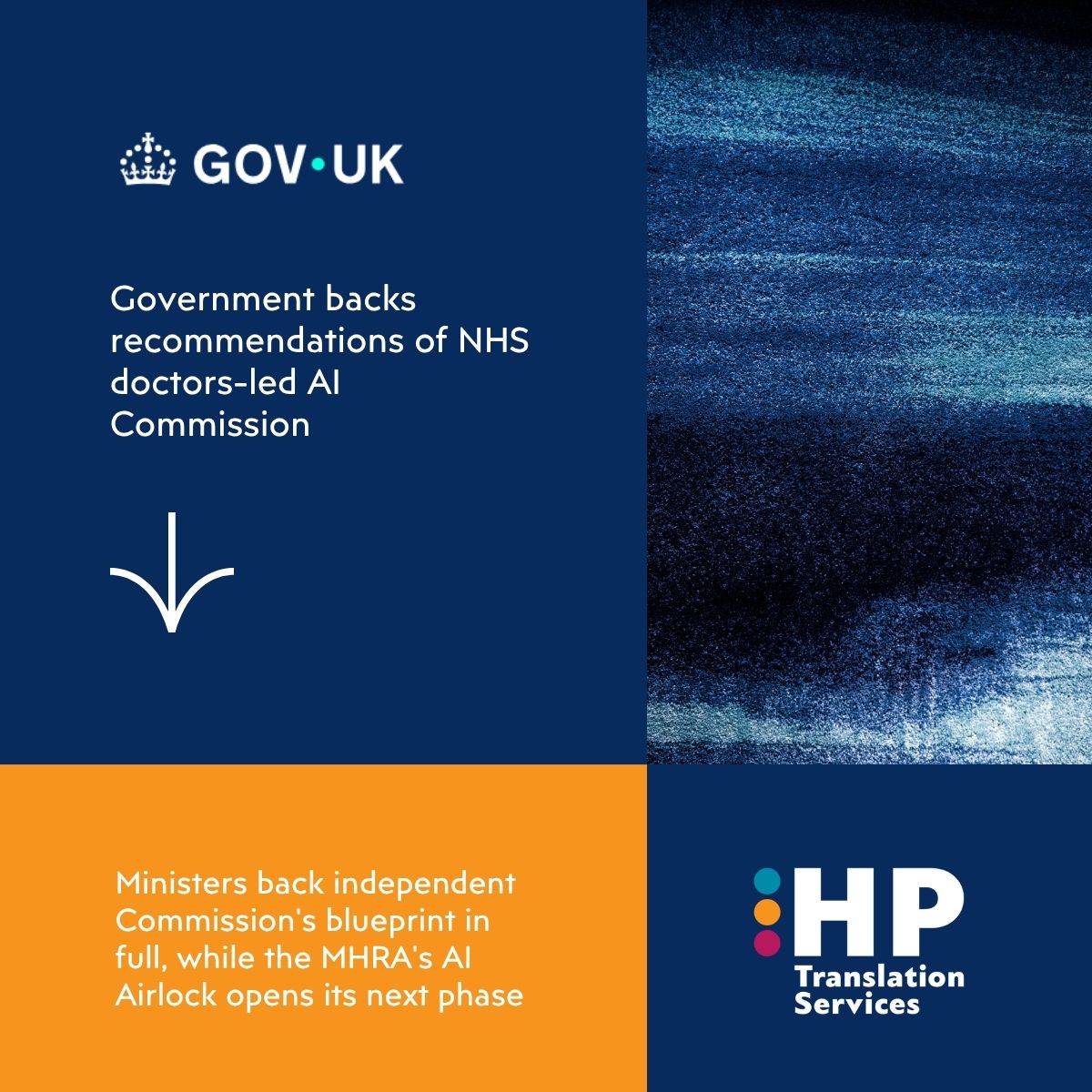
The UK Government’s endorsement of recommendations from the clinician-led National Commission into the Regulation of AI in Healthcare confirms a fundamental policy shift: AI-enabled medical technologies must undergo continuous, real-world monitoring throughout their working life rather than relying on point-in-time assessments, coupled with new commitments to keep patients informed when AI mediates their care.
While this dynamic framework aims to manage software evolution and model drift across diagnostic algorithms, it raises critical open regulatory questions regarding AI-enhanced translation and interpretation tools operating directly at the bedside.
It would be interesting to see whether the same principles will be applied to AI-enhanced translation and interpretation tools (standalone or implemented in medical and administrative devices) used in healthcare settings.
A major regulatory gap persists. Whether running as standalone apps or embedded in medical devices, AI translation tools directly influence triage, diagnostic, and treatment decisions daily. Yet, they are marketed as ready-to-use administrative software without strict medical device oversight.
There are questions that remain unaddressed. For instance:
What does human oversight mean in this setting? A clinician cannot oversee a medical translation output in real time if they cannot verify the target languages accuracy.
How do we govern these devices throughout their lifecycle?
What does post-market surveillance mean for these devices?
How can institutions continuously prove that a non-deterministic language model remains within its safe operating conditions as systems update and drift over time?
True clinical governance positions qualified language specialists at the core of the software and device lifecycle. Whether embedded in physician-facing software interfaces, medical device controls, or real-time clinical apps, safety cannot be retrofitted through superficial post-processing. It requires domain experts who establish clinical logic from code to bedside, govern terminology across live interactions, and take full accountability for the text. Integrating expert medical translation as a structural pillar ensures that every device, app, and clinical interface operates safely where technology meets patient care.