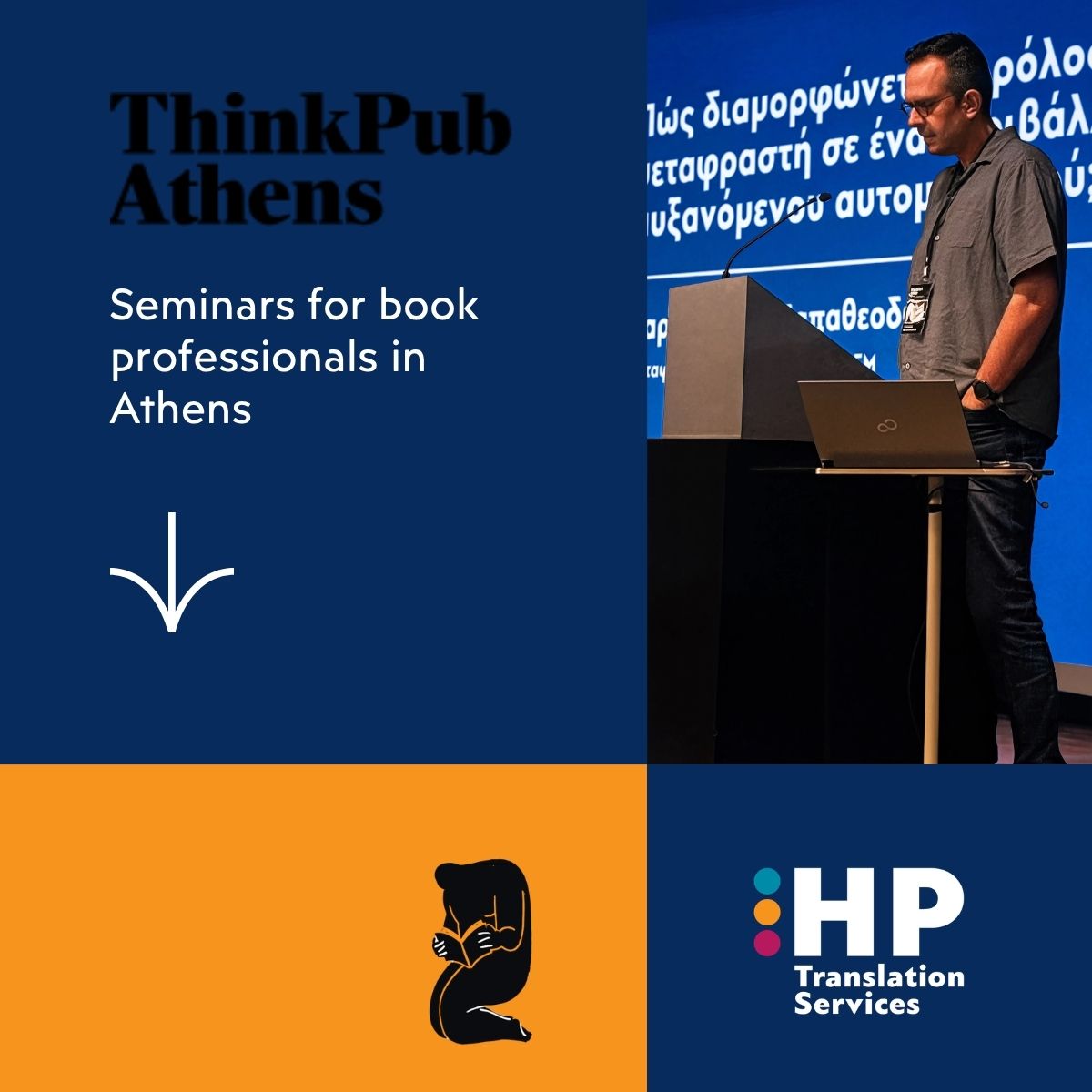
Just over two weeks ago, ThinkPub Athens brought together more than 230 publishers, translators, rights managers, and tech strategists at the Goethe-Institut Athen. Co-funded by Creative Europe and organized by Thinking alongside the Goethe-Institut Athen, the two-day event tackled the defining challenges facing modern publishing—from changing reading habits in the digital age to emerging technologies in smaller language markets.
One of the seminar’s core sessions focused on “Translation and the New European Rights Market.” Speaking on behalf of the Panhellenic Association of Translators as Vice President, I brought a practitioner’s perspective to a pressing industry question: How is the role of the translator shaped in an environment of increasing automation?
What Commercial Translation Teaches Us About Automation
While literary rights markets are currently confronting their first major wave of generative AI, commercial localization—software translation, technical documentation, and subtitling—has navigated successive waves of automation for over two decades.
Drawing from these industry precedents and my daily practice in specialized Greek medical translation, I highlighted critical parallels for publishers, language agencies, and technology developers:
-
The Illusion of Productivity: Every automated tool arrives with promises of reducing repetition and freeing humans for higher-level creative work. In commercial translation, it frequently led to platformization, depressed rates, and high-volume post-editing pipelines that induce severe cognitive fatigue.
-
Data Harvesting in Smaller Markets: In languages with limited digital training data like Greek, text corpora are regularly harvested to train models without the consent or compensation of the professionals who built those linguistic assets.
-
The “Good Enough” Narrative: Normalizing machine output as “good enough” risks creating a two-tier market—a race to the bottom for everyday content and an unverified reliance on software in high-stakes settings.
The Professional as Master of the Medium
Standing up for human-led translation is not a technophobic plea, nor does it mean retreating into print dictionaries.
It describes a professional who is a true master of their tools, someone who consciously decides when and how to leverage software, sets their working terms, and retains complete, accountable authority over the final text.
Whether evaluating a literary work or managing high-stakes clinical software and regulatory filings, semantic accuracy and safety cannot be retrofitted through superficial post-processing. True translation quality relies on human domain logic at the core of the workflow, where the specialist remains the ultimate decision-maker, not an uncritical post-editor.
My thanks to Michalis Kalamaras and the Thinking team for hosting a vital international dialogue on the future of language, rights, and publishing.